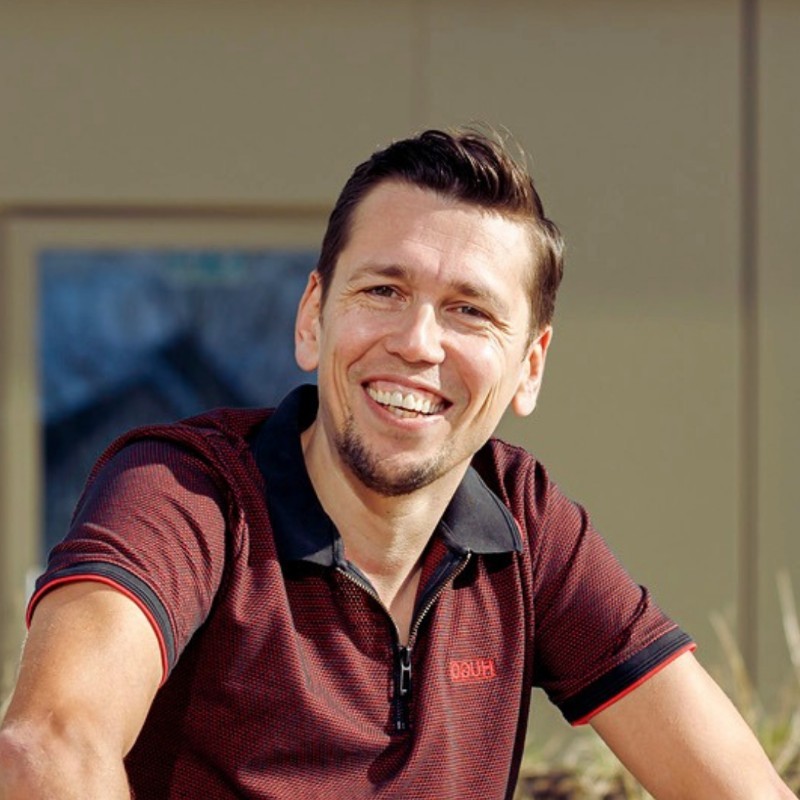
Career history
- FounderWintercircus
- FounderDeliverect
- Pitchdrive mentorPitchdrive

Insights & ideas
The through-line
Everything Jan Hollez says circles back to a single complaint about European ambition: it is too small, too slow, and too cautious with money. "Whatever you're thinking, think bigger" [7] is the instruction, and he applies it to himself as literally as he can, describing Deliverect's posture as "wij zijn niet gelijk welke start-up" [7] and then escalating: "Wij zijn zelfs niet wij willen de wereld veroveren. We wanna conquer the galaxy. I will bring a burger to the moon" [7]. The same conviction sets the intensity he expects from founders, since in his view "100% is niet genoeg in mijn ogen. Ik bedoel, ik zeg vaak je moet 300% door iets gaan" [7].
That preoccupation has moved domains rather than changed shape. The line "We hebben Googles nodig hier" [7] was first about a Belgian software company reaching unicorn scale, and is now about hardware, sovereignty and security: he is raising €150-250 million for the Smartfin Space & Defence Fund [1], on the argument that Europe stands at a turning point and that "als we meer autonomie willen, zullen we ook durven investeren in de technologie, bedrijven en ondernemers die dat mogelijk maken" [5].
On thinking bigger and what it costs
The bigness is not rhetorical positioning for investors, it is a filter on who should start a company at all. He is blunt that the trade is real: "Voor work life balance moeten moeten ja, dat is goed als je dat wilt, maar dan moet je geen start-up beginnen" [7]. The corollary is a test he applies to founders who are secretive about what they are building. If you will not say it openly, you have already failed, because if someone else can beat you simply by being more driven, you were not the right person to solve that problem [7]. Drive, in his framing, is the moat.
On scaling what works, not your problem
The most transferable lesson he carries comes from failure. Siruna raised too much money too fast and boxed itself in by pitching as B2B, so when the iPhone launched it could not pivot, despite having the only team that understood mobile development [7]. From that he draws the rule "Je moet schalen wat dat wat dat werkt en niet uw probleem schalen" [7]: capital raised too early makes you scale the wrong thing. Deliverect was deliberately restarted scrappy even though the founders already had money and experience [7]. The counterweight is a related failure mode he saw at scale, when Lightspeed, focused on its IPO, would only assign two people to delivery integration while the founders wanted at least twenty, which is why they left to found Deliverect [7]. He does not take no for an answer [7].
On what makes a product sell itself
Posios was, in his phrase, "product voordat product LED bestond" [7]. The founders were bad at sales processes, yet customers came to them anyway because the product did the selling, and he argues investors value that dynamic even more highly than the classic technical plus commercial founder pairing [7]. The same instinct shows in how he thinks about research: valorization at institutes usually fails because corporates will not outsource critical work and researchers move on to the next subsidized project, leaving prototypes in a drawer [7].
On fundraising as a permanent process
His playbook removes the moment of asking. You send continuous updates with stated targets to a long list of investors, then you hit those targets, so you become the party being chased and never raise with your back against the wall [7]. He insists the reporting discipline is less work rather than more: everyone is already up to date, ad-hoc questions dry up, and anyone who responds has pre-qualified themselves as interested [7]. He is equally deliberate about leverage in the room. Newion's Matthijs got exactly one chance at a record-high valuation, precisely because the fund had lowballed Posios earlier and now carried the FOMO [7]. Deliverect's progression from a €3M seed to €150M rounds was built on that discipline [7]. Staging matters too: negotiating with Lightspeed, the founders arranged one fancy sofa and two uncomfortable stools and took the stools themselves, to control the psychology of the meeting [7]. Being physically in the right place matters as much as any tactic, since moving personally to New York is what put Posios on the radar of an acquirer already scouting the hospitality vertical [7].
On European investors
His criticism of early European VCs is sharp and specific: they were worse than banks. "Alleé een bank is tenmin die weet dat hij een bank is en dat is logisch dat hij minder risico pakt. Maar van jullie het is risicokapitaal en je pakt niets van risico" [7]. Funds calling themselves risk capital only wanted to invest once everything was certain, so Posios financed itself with an ING loan secured on the founders' houses [7]. The habit of lowballing does more damage than a single bad price, because it kills momentum and future access to deals [7].
On space, defence and European sovereignty
The Smartfin Space & Defence Fund is the ambition argument applied to the continent [1][3]. Europe needs its own Googles in space and defence for sovereignty, and his diagnosis of the bottleneck is not money: capital and momentum exist, and what is scarce are people who can execute at the required speed [7]. He is raising €150-250 million for Europe's next generation of space, aerospace and defence champions [1], having flagged a fund with Jürgen Ingels before it was public [7]. The pitching is deliberately face-to-face and cross-sector, including a reverse investor pitch at Innovation Day alongside demos and pitches across defence, health, government, academia and investment [3], and public conversations aimed at carrying the story wider [5]. The framing stays consistent: autonomy requires the courage to fund the technology, companies and entrepreneurs that make it possible [5].
On investing his own money
He is candid that he got angel investing wrong at first, moving too eagerly and writing tickets that were too large [7]. The correction was structural rather than a matter of picking better: he now invests through funds, and only in domains he knows deeply [7]. It is the same logic as the fund itself, concentration where the knowledge is real.
On AI adoption and building a community around it
The community work runs on an explicit premise: share what you are learning, build a genuine community, and push the whole ecosystem forward together [2]. The GenAI series at the Deliverect office in Ghent is programmed around practitioners rather than theory, with sessions on who reviews the agents as the new bottleneck in software development, lessons from building an AI coworker, security and cost control in the vibe coding era, and building agents top-down rather than ground-up [4][6]. He describes the value as "real lessons from people actually shipping AI" and "real mistakes" [4][6]. Beyond the events, his interest is organisational: what it actually takes to rewire engineering orgs, drive AI adoption, and trigger compounding effects [2]. His read on the moment is simply that "the pace of innovation right now is wild" [2].
On buying back your own time
The most counterintuitive thing he did was learn to fly helicopters, and he did it because he had no time. "Ik had teveel ik had geen tijd en dus heb ik iets extra gedaan dat veel tijd kostte om te zorgen dat ik meer tijd" [7]. Committing to an enormous outside time investment forced him to build Deliverect so it could run without him and to delegate properly [7]. The constraint was the mechanism.
Takeaways
- Raise on your own terms by sending continuous updates with targets to a long investor list and then hitting them, so you are chased rather than asking with your back against the wall [7].
- Constant investor reporting saves time rather than costing it: fewer ad-hoc questions, and anyone who replies is already qualified as interested [7].
- Too much capital too early makes you scale the wrong thing, which is why Deliverect restarted scrappy despite the founders having money and experience [7].
- Secrecy is a red flag in a founder: if a more driven competitor can beat you on drive alone, you are not the right person for the problem [7].
- Europe's bottleneck in space and defence is not capital or momentum but people who can execute at the required speed [7], and closing it means daring to invest in the technology, companies and entrepreneurs behind autonomy [5].
- Concentrate your personal investing where your knowledge is deep, and go through funds rather than writing oversized angel tickets [7].
- Take on a large outside commitment deliberately if you want to force real delegation, as with learning to fly helicopters to buy back time [7].
- Run AI learning as an open community with practitioners presenting real mistakes, not vendors presenting theory [4][6][2].
Related profiles

This page shows public professional information only, each fact cited. Is this you? send a correction, or ask for removal within 24 hours, no questions asked.